Navigation
Quick access
Steering
Workspaces
Packages
Orientation
Service Intelligence Automation for existing ITSM and helpdesk systems
The intelligence behind your support system.
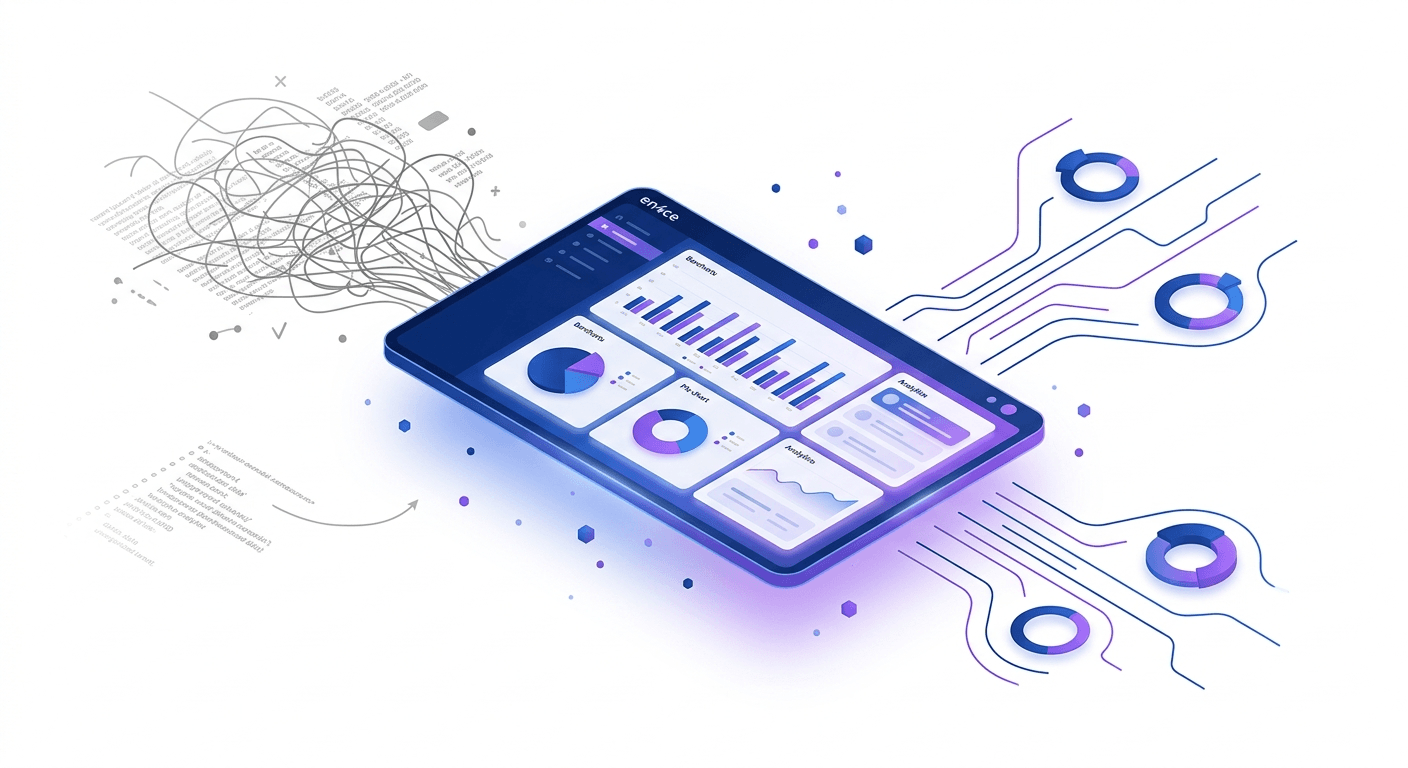
en4ce gives leadership one shared steering view across SLA, first response, backlog, utilization, and cost per ticket without replacing the systems already in operation.


Problem
You have reports. But no reliable management view.
In 2024, 87% of support teams reported rising customer expectations. At the same time, many organizations still operate with separate ITSM systems, helpdesk tools, shared inboxes, and side spreadsheets. The number of reports grows, but leadership still cannot see where SLA risk builds up, why first response times slip, or which teams are running past a healthy workload.
That is blind flying at management level: more data, not more steering quality. en4ce closes exactly that gap.
Solution
A steering layer above the systems you already run.
en4ce connects existing ITSM systems, helpdesk software, and ticket or issue-tracking systems, normalizes their data into one canonical model, and turns that into a shared leadership view.
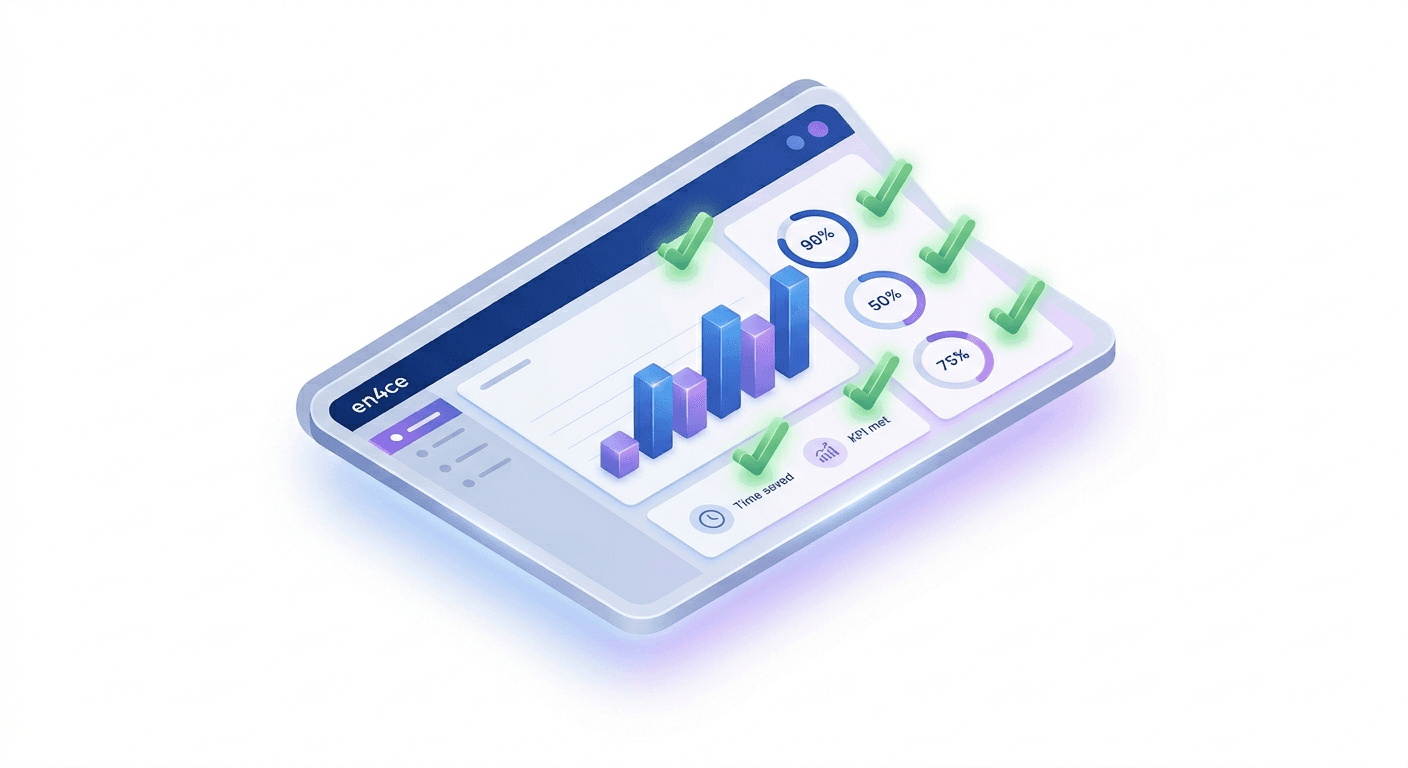
Instead of reading tool by tool, leadership sees what matters on one to two decision-ready pages: SLA attainment, first response, resolution time, backlog, CSAT, utilization, and cost per ticket across the full service landscape.
- One KPI logic for SLA, FRT, MTTR, backlog, and reopen rates
- Shared view of CSAT and cost per ticket across the entire service landscape
- Configurable dashboards that stay decision-ready instead of report-heavy
- Real-time signals for risk, workload, and action priorities
AI support
AI where it creates operational value. Off where it must stay off.
The SolarWinds ITSM Report 2025 reports that GenAI can reduce resolution time by up to 54%. en4ce uses AI for exactly that kind of measurable gain: pattern detection, compression, and prioritization. If your policies require it, AI can be fully disabled with no data flow into AI processing.
Early risk signals
Spot rising volume, queue pressure, and likely SLA breaches before the backlog turns into escalation.
Priority guidance
Reduce long ticket lists to the few actions with the strongest business and service impact.
Management context
Condense relationships across categories, teams, and handovers into something leadership can actually act on.
Integrations
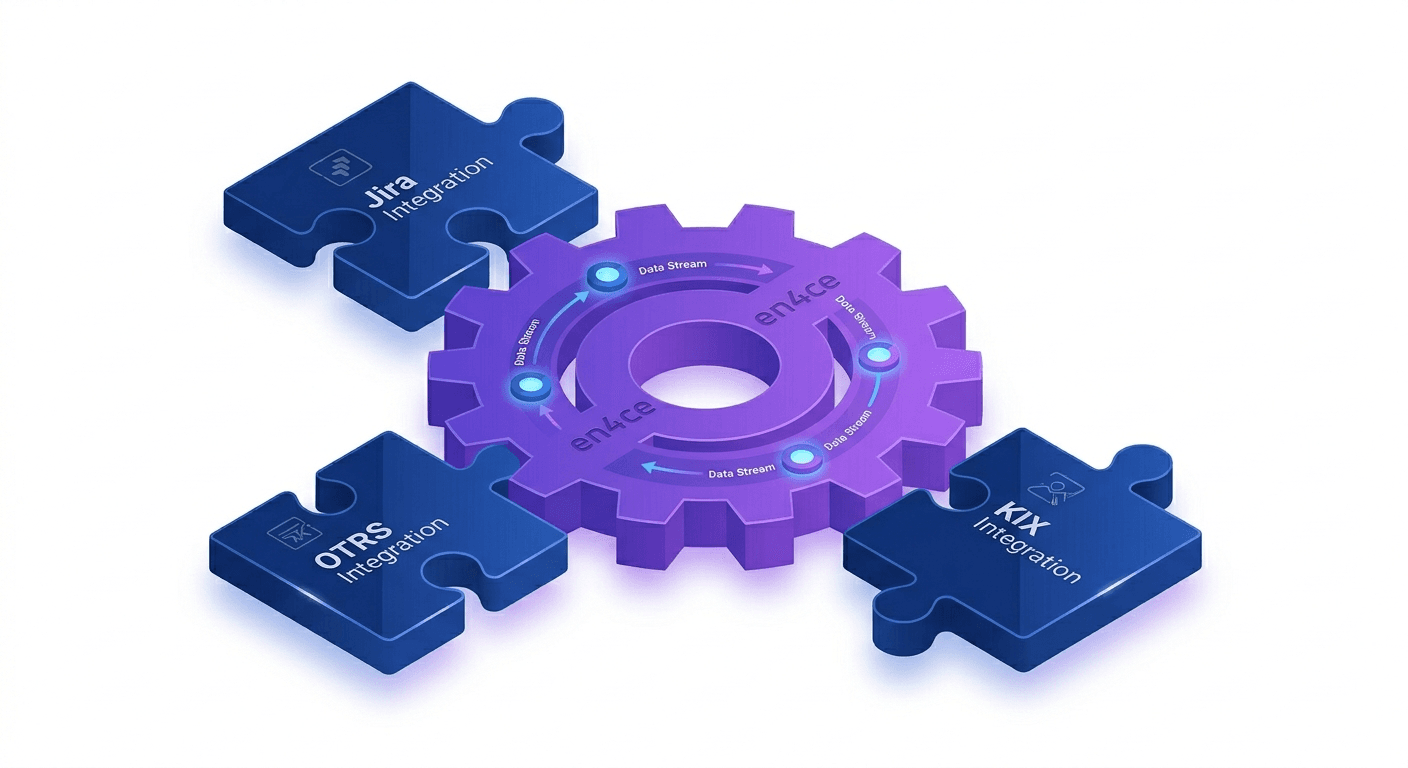
Your existing systems stay in place. en4ce adds the steering layer above them.
You do not need to replace a running ITSM system, retrain users, or start another ticketing rollout. en4ce connects to what already exists and builds the shared evaluation layer on top of it.
Cloud-based and locally operated systems are connected in the way that best fits the situation. For leadership, the point is not API theory. The point is that KPIs, risks, costs, and priorities from all relevant sources finally appear in one view.
Cloud systems via existing interfaces
Existing cloud platforms are connected through the interfaces they already provide. No secondary tool rollout, no detour through manual exports.
On-premise without a restart
Locally operated systems stay where they are. en4ce connects them without turning the project into a full replacement initiative.
Grows with your landscape
If new service areas, subsidiaries, or specialist sources are added later, the steering layer expands with them instead of starting over.
Privacy by Design
Privacy by Design.
Operational source data remains in tenant-isolated EU primary storage. For AI-supported evaluation, only the technically required, minimized, and redacted context is handed over.
AI processing within the West Germany operating region
AI processing remains within the configured West Germany operating region. Raw data, the canonical model, the retrieval layer, and the redaction logic stay separate, traceable, and tenant-isolated in EU-based data storage.
1
Tenant-isolated raw intake
Incoming data from APIs, connectors, or direct integrations is first stored in EU-based tenant-isolated raw intake layers.
2
Canonical model in PostgreSQL
Raw payloads are normalized into a shared operational model. This layer remains the primary source of truth.
3
Redaction before embeddings
Before embeddings and LLM usage, content is minimized, filtered, pseudonymized, or redacted so that only the required context moves on.
4
Tenant-isolated vector store
Tenant-isolated embeddings are generated from redacted chunks. The vector store is a retrieval layer, not a replacement for operational storage.
5
Context-minimized AI usage
Only the server-side AI layer hands over a tightly scoped, traceable context to AI services. There is no direct user-to-LLM path.
Business value
What you can manage better in practice
Finance-ready service view
Cost per ticket is one of the most requested CFO metrics in service operations. en4ce makes it available across systems instead of by tool and by assumption.
Workload before overload
A utilization range of 75 to 85 percent is considered healthy. Beyond that, burnout risk rises measurably. en4ce shows overload before attrition and escalation follow.
Service quality against benchmarks
First contact resolution around 70 to 79 percent and email first response under four hours are common reference points. en4ce shows where your operation stands above or below them.
Less blind flying in daily operations
Backlog, SLA risk, handover friction, and abnormal patterns become visible early enough to intervene before they become expensive.
Intelligence dashboard
This is what controllable service looks like.
If you need one compact, cross-system view of load, service quality, risk, and cost, we show you en4ce against your operating reality rather than against a sample database.